Optimizing Aerospace Die Cutting: Cost, Throughput, and Waste Reduction Strategies
Leveraging Process Engineering for More Efficient Production
From highly reflective optical management films in LEO satellites to thermal and electrical insulators in low-flying UASs (unmanned-aerial-systems), many demanding aerospace and satellite applications lean on custom die-cut components to perform mission-critical duties.
But aerospace innovators aren’t just looking for viable solutions on paper – they need assembly-friendly solutions that meet their tight launch timelines and budgets.
In today’s blog, the goal is to answer one key question: How does JBC help me manufacture my mission-critical aerospace components more efficiently and cost-effectively?
But as is often the case, to properly answer one question, you sometimes have to ask 5-more... So, I sat down with RJ Geibel, JBC's own Continuous Improvement Manager, and asked him some important questions about optimizing costs, improving production throughput, and reducing material waste for mission-critical aerospace components.
RJ gave some great battle-tested process engineering insight into the important role Design for Manufacturability and Assembly (DFMA) plays in optimizing the aerospace die-cutting process, and helpful cost and waste reduction strategies for die-cutting space-grade components.
Read on for a summary of our discussion!
WHAT ARE THE PRIMARY COST DRIVERS IN AEROSPACE DIE-CUTTING?
Before we dig into any strategies, we first have to understand the primary cost drivers associated with aerospace die-cutting projects:
Material:
To meet the highly demanding performance needs of many aerospace challenges, regular run-of-the-mill materials might not cut it. Critical challenges, especially orbital ones, like stray light mitigation, thermal overloading prevention, and secure low-outgassing bonding, often require a cast of highly specialized, engineered materials. These extremely capable materials do come with a higher price tag, especially for lower-volume production runs. Their specialized nature also makes finding budget-friendly alternatives a sourcing challenge.
How does JBC help? JBC has longstanding relationships with industry-leading suppliers of highly specialized engineered materials, including 3M™, granting us access to customized material solutions, helpful samples, and even the opportunity to schedule a custom 3M™ Solutions Seminar™. Solutions Seminars™ are a special in-person event that connects your engineering team with engineers from 3M™ and JBC Technologies to identify, discuss, and address challenges your team is currently facing. To learn more and request a customized Solutions Seminar, check out this page: Schedule a Solutions Seminar with JBC Technologies and 3M™
Quality Control/Tooling:
In aerospace manufacturing, the risks are simply higher. “Space-grade performance” means highly precise components that don’t fail, even during long missions in harsh orbital environments. Mission-critical components often require very tight die-cutting tolerances, which can drive up tooling costs. Pair this with the fact that these materials come with a high price tag, and one defective part can lead to some expensive waste. Quality control is a critical cost metric here.
How does JBC help? JBC implements rigorous quality systems and quality frameworks to prevent part defects in the first place. On certain machines, JBC implements a multi-camera inline vision system that picks up defects in real time, able to catch even the slightest deviation in part dimensions or features. This helps us catch problems in the die-cutting process as soon as they happen to minimize the amount of material and time wasted. For machines without inline vision systems, JBC leans on our ISO 9001-certified quality management framework, ensuring we perform regular line checks, quality audits, and more.
HOW DO DIFFERENT DIE-CUTTING TECHNOLOGIES COMPARE IN TERMS OF INITIAL INVESTMENT, OPERATIONAL COST, AND PER-PART COSTS ACROSS DIFFERENT PRODUCTION VOLUMES?
The three main categories of die-cutting technology, rotary, flatbed, and digital (dieless) cutting, each come with their own unique pros, cons, and best-use cases. The right process for your project depends on your manufacturing and development goals. Let’s take a quick look at the cost breakdown for each die-cutting process:
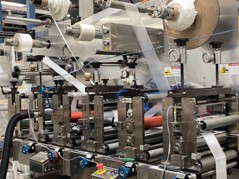 Rotary Die-Cutting
- Initial Investment: High
- Operational Cost: Low
- Per-Part Cost:
- Prototyping: High
- High-volume production: Low
- Best for: High volumes of small to medium-sized complex parts
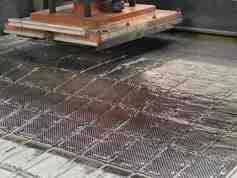 Flatbed (Platen) Die-Cutting
- Initial Investment: Medium (Less than rotary, higher than digital)
- Operational Cost: Low to medium
- Per-Part Cost:
- Prototyping: Medium - high
- High-volume production: Lower than dieless, higher than rotary
- Best for: Medium to high volumes of large, thick, complex parts
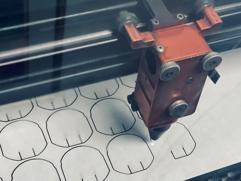 Digital/Dieless Cutting
- Initial Investment: Low due to lack of tooling
- Operational Cost: High due to engineering input
- Per-Part Cost:
- Prototyping: Low
- High-volume production: High
- Best for: Prototyping trials or low-volume production runs
WHAT ARE THE HIDDEN COSTS OF INEFFICIENT DIE-CUTTING, AND WHAT STRATEGIES CAN HELP IDENTIFY AND MITIGATE THEM?
The hidden costs of inefficient die-cutting typically manifest in one of a few ways: increased machine downtime, unnecessary rework, longer lead times, and wasted expensive engineered materials.
So, how can this be mitigated? Simply put, the best way to avoid these unnecessary hidden costs is to work with a truly capable, vertically integrated converting partner as early as possible to leverage and design for manufacturability and assembly (DFMA) considerations into the die-cutting process. In aerospace die-cutting, you're often working with tight production timelines and demanding project launch schedules, making early communication and go-to-market readiness critical.

Vertical integration - A vertically integrated converter, like JBC Technologies, helps keep all of the critical converting processes, like slitting, laminating, and die-cutting, in-house, helping boost production throughput and overall process control.

Design for Manufacturability and Assembly (DFMA) - This helps us detect inefficiencies and potential risks that may gunk up the die-cutting process. When done early enough, it gives us ample time to tweak the design of the part (with the customer's approval) or engineer the process to eliminate factors that cause rework, scrap, and machine downtime, helping boost lead times and overall cost/time efficiency.
JBC’s DFMA risk mitigation and process validation can be broken down into a few key steps:
PFMEA
Process Failure Mode and Effects Analysis (PFMEA), is a pivotal part of the NPL (new product launch) and DFMA process. Think of this as a proactive risk map, helping us understand where a process might fail and why, before it does. It helps us answer questions like:
-
Failure Mode: “What could go wrong?”
-
Effect: “What happens if it does?”
-
Cause: “Why would it happen?”
-
Controls: “How do we stop it?”
IQ, OQ, & PQ
Installation qualification (IQ), operational qualification (OQ), and performance qualification (PQ) are the action items that make up Process Validation. These are the questions we ask to ensure that the converting process will actually work in practice:
-
IQ – “Is all of the necessary die-cutting and converting equipment installed and set-up correctly?”
-
OQ – “Can the process hold up under extreme circumstances and worst-case scenarios?”
-
PQ – “Does it work day in and day out, over the course of long-term real-world production?
Prototyping & Production Trials
Low-volume prototyping runs and production trials act as the final catch-all for any process inefficiencies or challenges that haven’t been identified up to this point.
-
Prototypes completed on our digital cutting machines help you quickly test for fit, form, and function before finalizing the design of a component.
-
Production trials are small-volume runs completed on production equipment to validate that the die-cutting process actually works, ensuring the design, material, liner, and tolerances are all actually manufacturable in practice.
JBC Technologies: Optimizing Mission-Critical Manufacturing
Working with JBC Technologies early in the development process of mission-critical aerospace components allows us to do what we do best: optimize the product and process for cost/time efficiency and space-grade performance.
JBC Technologies was founded on the core principles of process engineering innovation, manufacturing excellence, and supply chain optimization. These core pillars are the building blocks for how we provide value-added die-cut solutions for a wide range of aerospace and satellite challenges, including brightness mitigation and optical management, thermal insulation, EMI/RFI shielding, gasketing, sealing, and more. We help aerospace OEMs and innovators prototype fast, scale easily, and launch faster. 
Do you have an aerospace converting project that you’d like us to help with?