
High Volume Nasal Strip Die-Cutting and Contract Manufacturing
JBC Technologies is a US-based ISO 13485 Certified Manufacturer of custom nasal strips and nose tapes, with years of experience converting medical-grade skin-contact materials into functional nasal strip solutions.Through our high-volume rotary die-cutting equipment, process engineering expertise, and custom printing, labeling, and packaging solutions, JBC is a key partner for scaling your custom nasal strip project from prototype to production.
Precision Converting for Complex Nasal Dilator Stack-Ups The Anatomy of a Nose Tape
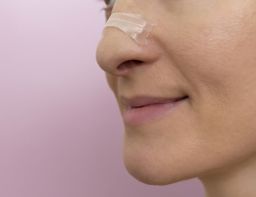
The bridge of the nose is a challenging area to stick anything to – it's curved, has a high concentration of oil and sweat glands, and is home to sensitive skin. All of which are factors that can drive adhesive failure.
You need a capable manufacturing partner who understands this and can leverage material and process engineering expertise to manufacture mouth tape that stays stuck.
At JBC, our ability to help nasal strip brands scale their nasal strip production starts with our in-depth understanding of nasal strip design...

Liner The Adhesive Protector
Nasal strips must be placed correctly over the bridge of the nose, which is an already challenging location to adhere to. Consumers must be able to successfully line up and place the product without contaminating the exposed adhesive with their fingers.
Through JBC’s kiss-cutting capabilities, we can accommodate back-scored liners, allowing consumers to remove only part of the nasal strip liner, leaving the rest of the adhesive covered and protected for easier handling and application.
Common Materials:
-
PET – Provides a rigid surface that adds dimensional stability to the die-cutting process; Commonly used for high-volume parts on rolls or sheets
-
PCK (Poly-Coated Kraft) Paper – Increased stiffness for better handling; Commonly used for individually packaged products

Adhesive The Skin-Contact Layer
Nasal strip adhesives are unique in that they must adhere evenly across the bridge of the nose while resisting the spring-back force generated to dilate the nasal passage.
Selecting an adhesive with high enough shear strength to resist adhesive “creep” and edge lifting is crucial for keeping the strip adhered. Leveraging JBC’s rapid prototyping services to perform real-world wear testing is a quick and low-cost way to validate that your nasal strip stack-up stays adhered under spring-tension and removes safely from different skin-types.
Common Materials:
-
Acrylic Adhesives – Offer high-initial tack and creep-resistance; Commonly used for overnight wear and high-tension nasal strips
-
Silicone Adhesives – Provide gentle adhesion that removes safely; Commonly used for consumers with sensitive skin

Carrier Film The Structural Backbone
In nasal strips, the carrier film is a flexible substrate that provides structural support for both the adhesive and the plastic mechanical lift strips. Carrier films must help distribute the mechanical spring force across the entire surface area of the nasal strip, which prevents premature delamination or edge-lifting.
JBC’s inline multilayer laminating capabilities allow us to combine multiple materials together, like the many layers of a nasal strip, in a single machine pass to yield functional multi-layered nose tape products quickly and efficiently.
Common Materials:
-
Nonwovens – Soft, cloth-like feel and high breathability; Commonly used for overnight applications where comfort is a priority
-
PE Films – Low profile, “no-show” appearance; Commonly used for aesthetic “no-show” applications and sports wear

Mechanical Spring Ribbon The Airway Opener
The mechanical heart at the center of the nasal dilator strip is the mechanical spring ribbon, which generates the tensioning force required to help flare the nostrils outward. This functional layer must have high spring-back memory and tensile strength, allowing it to apply a consistent lift-force for the entire wear duration.
Not only do these spring ribbons need to be strategically placed in the same location within each nasal strip footprint, but they also need to be done so repeatably for thousands of high-volume parts. For this, JBC leverages our inline island placement capabilities, which allow us to time the placement of each ribbon so they land in the same precise location on the moving material web of our multi-station rotary die-cutting presses.
Common Materials:
-
Polyester – High memory plastic that provides consistent tension over time; Commonly used for: Standard breathing strips

Top Laminate Cover The Sandwiching Aesthetic Layer
In nasal strips, the top-laminate cover serves as the protective facestock for both aesthetic and functional purposes. The top cover sandwiches the spring ribbons and adhesive carrier together to prevent the ribbons from delaminating or catching on clothing, while providing a soft-to-the-touch user-friendly surface.
For external aesthetic layers like this, JBC’s digital printing capabilities allow us to full-color print branding, instructions, logos, and aesthetic designs right onto the nasal strip fabric itself.
Common Materials:
-
Polyurethane Films – thin film with a high Moisture Vapor Transmission Rate (MVTR); Commonly used for “Clear” strips with a discrete, skin-like finish
-
Nonwovens – Provide a soft textile feel for extra comfort: Commonly used for overnight wear

Partner Effectively!
Finding a nasal strip manufacturer that understands how to source, combine, and process these dissimilar material layers together is crucial to taking your nasal strip product to market quickly and effectively.
Not only do we have an extremely knowledgeable technical and process engineering team, but we also have tight relationships with the industry’s leading adhesive suppliers. Working with key suppliers like Avery Dennison and DermaMed, we can ensure you have access to a wide variety of important nasal strip material information and samples.
Manufacturing Capabilities for Multi-Layer Nasal Strips
JBC is a full-product lifestyle partner, executing nasal strip manufacturing from prototype to production, employing design for manufacturability and assembly strategies to ensure your nasal strip product is retail-ready once it leaves our facility.
How do we do it? Engineering Innovation, Supply Chain Optimization, and ISO 13485 Certified Manufacturing Excellence. Capabilities we use to fabricate high-quality nasal strip products include:

Complex Multi-Layer Laminating Services

JBC Technologies offers a full range of laminating services, including hot lamination, cold pressure lamination — both inline, and wide web. This gives our process engineers the flexibility to choose the right process for material, application, production volume, and value.
From bonding a pressure-sensitive adhesive to a foam gasket to marrying two complementary materials into one multifunctional component, we help you simplify your supply chain, reduce SKUs, and streamline your assembly process.
High-Volume Rotary Die-Cutting
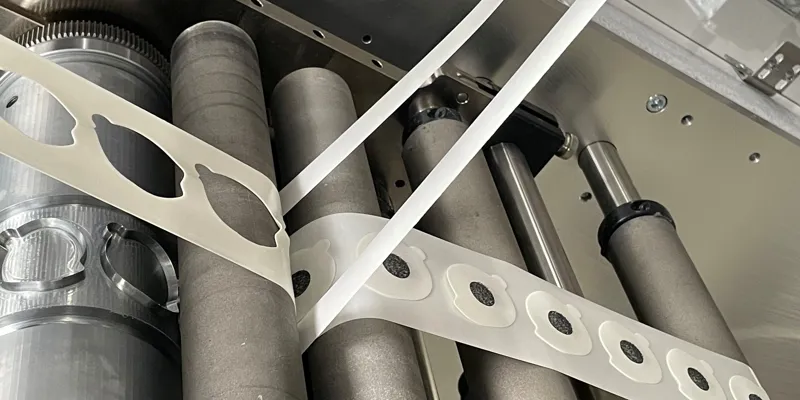
JBC's fleet of multi-spindle rotary die-cutting machines is a core part of our commitment to manufacturing excellence, allowing us to fabricate thousands of dimensionally identical multi-layered components repeatably at high-speeds.
With machines ranging from 5-18 stations and a variety of inline capabilities like laminating, printing, ultrasonic welding, island placement, and more, our rotary die-cutting capabilities are critical to our "one-pass-approach" to manufacturing, helping us get more done in a single machine pass.

Custom Printing
JBC Technologies offers full-color in-line digital printing services for custom-printed flexible parts and components - serving medical device manufacturers, consumer wellness brands, and industrial OEMs.
Featuring full-CMYK printing, 600 or 1200 dpi resolution, and variable data printing, our printing capabilities allow to us apply branding, custom patterns, printed instructions, and more directly onto the die-cut component itself, helping streamline the entire converting workflow.

Rapid Prototyping
Powered by our digital cutting capabilities, JBC's rapid prototyping services are an excellent resource for design engineers looking to quickly and cost-effectively test different materials or validate proof of concept for die-cut components.
Our digital cutting machines can quickly produce parts that would normally be die cut, taking them from CAD drawing to finished part in seconds with no tooling required. In higher-risk industries like the aerospace, medical, and consumer wellness space, this is an important step for validating the fit, form, and function of mission-critical components.
Custom Nasal Strip Manufacturing: Answers to Common Questions
Right here! JBC Technologies is proudly based in the United States, with multiple domestic manufacturing facilities. As a domestic die-cutter and nasal strip manufacturer, JBC helps OEMs and startups avoid tariff fluctuations, consolidate long overseas supply chains, and boost go-to-market speed.
The most commonly used adhesive for nasal strip manufacturing is typically an acrylic-based stick-to-skin adhesive. Acrylic adhesives provide high shear, resistance, strong initial tack, and durable adhesion, especially for medium-to long-term wear. These factors, particularly their high-shear, are crucial for preventing the nasal strip from delaminating under the elastic stress of the nasal strip pulling outward on the nasal passages.
However, the adhesive only makes up one-half of a functional medical-grade tape. Pairing an acrylic adhesive with the right carrier is also critical for designing a functional nasal strip. Polyethene and polyester films are typically used in nasal strip manufacturing to provide a flexible structural integrity that adheres across the bridge of the nose without causing edge-lifts. It’s also critical that the carrier be breathable with a high-moisture vapor transmission rate (MVTR) to prevent moisture from building up underneath the tape, which can lead to adhesive sliding and failure.
Yes, JBC Technologies is capable of manufacturing custom-shaped nasal strips thanks to our advanced multi-station rotary die-cutting capabilities and team of degreed engineers. Our ability to combine and process multiple dissimilar materials into a single multi-layered, retail-ready nasal strip makes us efficient for high-volumes of dimensionally identical nose tape products. As an ISO 13485 Certified converter with experience converting medical-grade materials, we understand the biocompatibility and quality requirements necessary for manufacturing skin-safe nasal strips. Our nasal strip manufacturing capabilities include:
-
Custom nasal strip shapes
-
Custom printed nasal strip designs
-
Custom nasal strip packaging
-
Custom nasal strip branding and labeling
JBC provides a wide range of packaging options for nasal strip applications. We strive to understand where your nasal strips will go after it leaves our presses and provide an optimized packing solution. Whether it’s retail-ready packaging or custom kitting and labeling for post-processing and automation needs, we can help package your nasal strips in cans, tins, boxes, sleeves, cartons, and more!
Yes, JBC Technologies manufactures custom color-printed nasal strips. We leverage in-line printing and die-cutting capabilities to bring you custom printed designs, instructions, packaging, and labels for both retail and automation-ready applications.
Your ISO 13485 Certified Partner for USA-Made Nasal Strips
Bringing a custom nasal strip to market requires more than just a die-cutter; it requires a partner who understands the nuances of skin-contact science. By combining our ISO-aligned manufacturing with a robust supply chain of medical adhesives, JBC Technologies delivers the precision your product demands.
Ready to scale your production?