How to Scale Mouth Tape Production: Leveraging Process Engineering to Prevent Product Failure
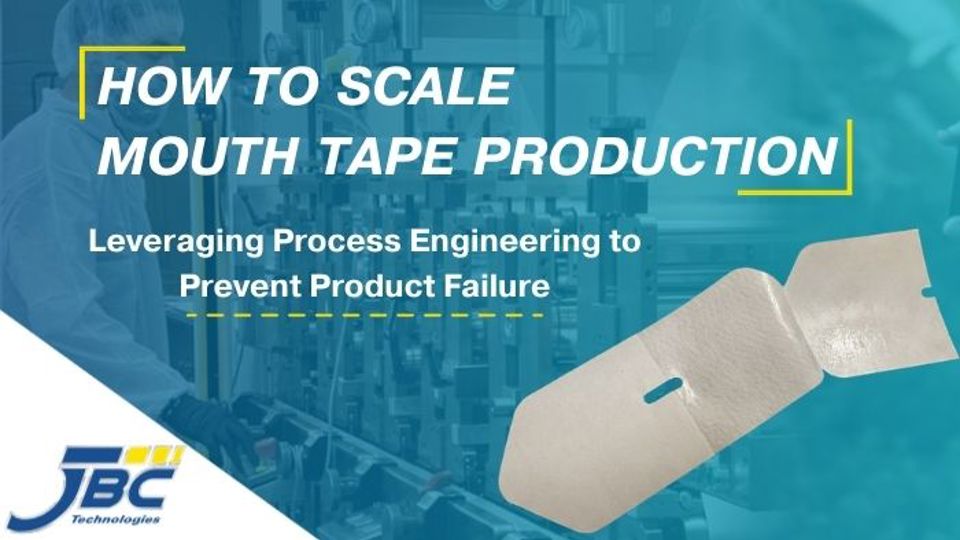
Not all mouth tape designs are scalable..
Lifestyle and consumer wellness brands developing a mouth or sleep tape product are typically striving for designs that are:
- Efficiently and repeatably manufactured at scale
- Retail-ready and reliable in the hands of the consumer
Standing in the way of this, is what we here at JBC like to call, the prototype to production gap. In short, this is the gap between a small-batch prototype and a functional mouth tape design that can be manufactured repeatably and efficiently at high volumes.
Hand-cut prototypes, while useful, don't accurately reflect the real-world process of high-volume rotary die-cutting, leading to designs that don't translate when it's time to move forward with full-scale production.
Today, we'll be highlighting a few common pitfalls we see in customer-supplied mouth tape design, helpful design for manufacturability and assembly recommendations (DFMA) to address them, and what JBC Technologies does from a processing standpoint to ensure your design integrity is maintained from the first unit to the millionth.
Let's get into it..
Vent-Hole Geometry and Slug Management
Emergency breathing cut-outs/vent-holes are a critical mouth tape design element, offering the user an alternative breathing path in case airflow through the nose becomes blocked. However, punching out these intricate holes often creates slugs, or tiny pieces of adhesive waste. Without proper slug management, these little pieces of waste can make production inefficient and messy, especially at scale.
To combat this, JBC leverages DFMA recommendations that may eliminate the slug entirely. For example, instead of a vent-hole, a cross-hatched pattern may do the same job without cutting out any slugs.
If a full cut-out is necessary for the design, we may recommend making the cut-out larger, as large slugs are easier to manage than little ones. Here are some common rules of thumb for optimal slug management design:
- Avoid slugs smaller than 1.5-2x the material thickness
- Avoid needle or crescent shapes
- Combine small holes into one large slot when possible
When slugs are unavoidable, these are the capabilities we leverage to manage them effectively:
|
Method: |
Best Used For: |
Features: |
|---|---|---|
|
Stripping / Eject Pins |
Large or stiff slugs |
Positive mechanical release |
|
Pulse Air |
Adhesive heavy webs |
Timed bursts prevent reattachment |
|
Vacuum Collection |
Continuous slug flow |
Prevents buildup in cavities |
|
Spring Plungers |
Prototypes / short runs |
Quick to swap, tunable force |
|
Air Eject |
Delicate liners |
Lower force than pulse air |
Sharp vs. Rounded Corners
Sharp corners may look sleek on a hand-cut prototype, but die-cutting them at high-volumes is a different story...
Sharp 90-degree angles can create stress-risers, which compromise the functionality and structural integrity of a mouth tape product during both processing and application.
 During processing: Sharp angled "stress-risers" are more prone to tearing and other defects during high-speed rotary die-cutting, leading to machine downtime and increased material waste. Sharp-angled dies also wear out quicker than rounded tooling.
 During application: These sharp angles can lead to “edge-lift”, causing the tape to peel away prematurely. Sharp corners are also more prone to snagging on clothing, bedding, or other surfaces.
The solution? By understanding this before finalizing your mouth tape design, you can instead opt for rounded corners wherever possible, eliminating these stress risers entirely. Now, we're not telling you how to design your mouth tape product, just arming you with the information necessary to avoid these hiccups wherever possible.
Why Rounded Corners Work
|
Equal Tension Distribution |
“Snagging” Prevention |
Production Efficiency |
|---|---|---|
|
Softer-angled corners distribute tension more evenly across the adhesive bond, creating a more reliable stick. |
Rounded corners sit much more flush on the skin, making them less likely to snag on clothes or bedding. |
Rounded corners are more efficient to die-cut, decreasing the chance of defects and improving scalability across high-volume manufacturing. |
The result is two-fold: A higher-quality mouth tape design that's easier to manufacture at scale, and a retail-ready mouth tape product that doesn't fail in the hands of the consumer.
Easy-Release Liner Integration
As an over-the-counter consumer wellness product, mouth tape products need to be consistently and easily applied by consumers. If the end-user has to struggle to peel it off of the liner, the mouth tape's performance is compromised before it even touches the skin.
From a process engineering standpoint, we're able to accommodate a wide variety of optimized easy-release liner constructions, including extended liners, pull-tabs, and adhesive dead-zones during our high-volume rotary die-cutting operations.
How It works:
 What we do: We accommodate pull-tab and extended-release liner integration on our multi-station rotary die-cutting presses, featuring value-added capabilities like in-line lamination, kiss cutting, and multi-die registration. We're able to convert and integrate liners that extend beyond the footprint of the product, finger-lift tapes that help the user peel-and-stick without touching the adhesive, and adhesive dead-zones so the product doesn't stick to the user's
fingers during application - all per customer specifications.  How it boosts scalability: By seamlessly adding pull-tab and extended liner integration into our high-volume rotary die-cutting processes, we're able to yield high-volumes of finished products optimized for user handling with one machine pass. This 'one-pass-approach" turns user experience from a wish-list item to a repeatable, scalable feature.
From Prototype to Production: Let JBC Help You Scale
These design tweaks may seem small, but they’re often the difference between a successful product launch and frustrating reworks – impacting both production efficiency and your bottom line. The key here, is working with an experienced converting partner who is well versed in die-cutting and converting high-volumes of medical-grade skin-safe materials into retail-ready finished wellness products.
As an ISO 13485 certified Solventum Premier Converter, JBC helps wellness brands and startups scale their mouth or sleep tape products from prototype to production, providing high-volume manufacturing services for mouth tapes, nasal strips, fashion and beauty tapes, transdermal tapes, and more.
Founded on the pillars of supply chain optimization, engineering innovation, and manufacturing excellence, JBC understands the process engineering behind medical and consumer wellness tape manufacturing, helping you yield high-quality finished products repeatably and cost-effectively.

Do you have a mouth tape project you'd like to get started with?