
Custom CGM Overlay Patch Manufacturing

CGM Overpatches: Materials Science Meets Precision Converting
CGM overlay patches, commonly referred to as overpatches, are a protective outer layer that are used to keep stick-to-skin CGM devices safe and secure for their required 7-14-day wear time. At JBC, we provide the process engineering experience necessary to make a functional CGM overlay patch, pairing our materials science knowledge with advanced converting capabilities to yield finished overlay patch products optimized for performance and long-term wear.

Stick-to-Skin Longevity
While CGM devices come with their own skin-contact adhesive, they sometimes struggle to meet the required wear-duration of medium to long term wear.
Through our many relationships with industry-leading medical-grade adhesive manufacturers, JBC helps CGM overlay patch brands source, select, and test the right long-term skin-contact adhesive that will keep their overpatch product securely attached to the skin, ensuring that the CGM device below it remains safely adhered for the desired wear time.

Personal Style
Consumers often want to steer away from the “medical” look of a CGM device. Custom printed overlay patches allow them to add their own personality to their wearable device.
Through our full-color printing capabilities, we help our customers deliver custom-printed designs for branded CGM patches, including everything from custom-printed packaging, instructional information, or aesthetic patch designs.

Protection During Strenuous Activity
For active consumers, overlay patches are commonly used to protect CGM devices during activities like running, biking, swimming, and other sweat-inducing activities. However, with so many different medical-grade adhesives on the market, sourcing and selecting one that you know will hold up in these circumstances can be a challenge.
JBC’s rapid prototyping services help CGM patch brands quickly and cost-effectively conduct real-world wear studies to ensure their selected materials and patch design actually hold up during strenuous activities.

Transmitter Safety/Reusability
While CGM overlay patches must stick to the skin, it’s critical that they don’t adhere to the CGM transmitter itself. Overlay patches need to be easily removed without sticking to and potentially damaging the sensitive device transmitter.
JBC’s island placement capabilities allow us to apply a strategic adhesive “dead-zone” directly onto the center of the patch during processing on our rotary die-cutting presses. This yields thousands of dimensionally identical patches that won’t stick to the center of CGM Devices with sensitive transmitters, like the Dexcom G6.
The Anatomy of a Protective CGM Overlay Patch
Let’s break down what makes up a skin-safe adhesive tape used for manufacturing CGM Overlay patches:

The Easy Application Liner
CGM overpatch application presents unique challenges. These patches can be larger than other consumer wellness tapes and must be precisely aligned over an existing device on the skin.
To enable easier placement, JBC offers back‑scored liners and easy‑release pull tabs produced on our high‑volume rotary die‑cutting presses. These liner features enable one‑handed peel‑and‑place application, helping consumers position the patch accurately without touching or compromising the adhesive.
Common Materials:
· PET – Rigid, stable surface for high-volume manufacturing; Commonly used for: Large volumes of patches supplied on rolls
· PCK (Poly-Coated Kraft) Paper – Stiff material, optimized for consumer handling and application; Commonly used for: Individually packaged products

The Adhesive
CGM overlay patch adhesives must stay adhered for 7-14 days of constant moisture, sweat, and friction without irritating the skin or delaminating. Overpatch adhesives require high-shear strength to resist the transmitter tugging at the skin, and a high-moisture vapor transmission rate to prevent moisture build-up.
JBC’s rapid prototyping services help you perform real-world wear tests to quickly compare materials and select the right skin-contact adhesive before committing to full-volume manufacturing.
Common Materials:
-
Medical-Grade Acrylic Adhesives – High-tack and aggressive long-term bond; Commonly used for: Patches for those with active lifestyles
-
Extended-Wear Silicone Adhesives – Gentle and repositionable medical-grade adhesive; Commonly used for: Sensitive skin-applications

The Carrier
CGM overlay patch carriers require high enough flexibility to conform to the body’s natural contours and movements, while being rigid enough to provide the main structural integrity of the overall patch stackup.
Through our long-standing relationships with many industry-leading medical-grade material suppliers, JBC can help you identify, source, and sample a wide variety of medical-grade carrier materials to find the one that works best for your application.
Common Materials:
-
Nonwovens – Highly breathable and conformable fabric; Commonly used for:
-
Polyurethane (PU) Films – Waterproof, transparent barrier; Commonly used for: Thin, low-profile applications that survive showering /activity

The "No-Adhesive" Zone
Most CGM overpatches feature a non-adhesive zone at the center of the patch, where the device transmitter sits. This no-adhesive zone can be achieved in two ways:
-
By cutting out a center hole, exposing the entire transmitter
-
Or by applying a strategic adhesive “dead-zone” in the center of the patch
If the customer specifies an adhesive “dead-zone” rather than a cut-out, JBC’s inline island placement capabilities give us the ability to strategically place a non-adhesive layer in the center of the CGM stackup. We’re able to complete this in-line on our multi-station rotary die-cutting presses, yielding thousands of dimensionally identical finished products with the required dead-zones all in one machine pass.
Selecting the Right Adhesive:
Top Skin-Contact Adhesives for CGM Applications
Selecting the right skin-contact adhesive for your CGM overlay patch can be daunting. With so many hypoallergenic stick-to-skin adhesives on the market, how do you know which one is right for your project?
We put together this guide, which highlights some of the common skin-contact adhesives manufacturers turn to for CGM applications. It can be a good place to start if you're unsure and looking for some inspiration!
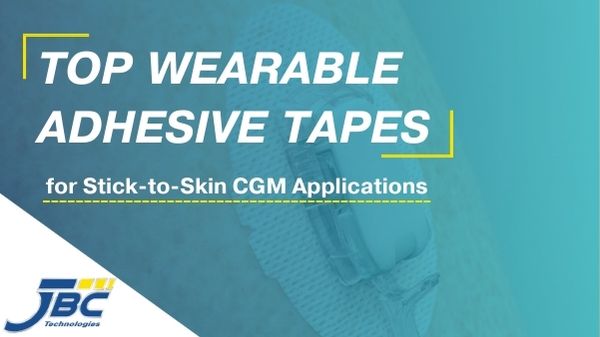
Learn More: Read our BLOG!
Here are just a few of the industry-leading medical-grade material suppliers we work with:
We also work with customer-supplied material. If you have material that you need converted, please reach out to your sales representative or contact us for additional information.





Commonly asked CGM Overlay Patch Questions
JBC is a U.S. Based domestic manufacturing partner for custom over-the-counter CGM overlay patches. With all of our facilities located within the United States, JBC helps CGM overpatch brands avoid long overseas supply chains and tariff fluctuations while boosting go-to-market speeds.
A common adhesive found in CGM overlay patches is medical-grade acrylic adhesive. Acrylic adhesives are typically chosen for their high-tack, creep-resistance, and long-term skin-contact adhesion, making them a reliable option for keeping CGM patches secure during exercise for up to 10-14 days.
Another common option is silicone-based adhesives. Silicone adhesives feature less tack, making them more repositionable and gentler on the skin. Designers may look to silicone for sensitive-skin applications where atraumatic removal is paramount.
These are not one-size-fits-all solutions, though. It's important to work with your converting partner to conduct real-world wear tests, ensuring your adhesive works as specified before the material is locked into your design.
Yes, JBC can manufacture custom-printed CGM overlay patches using our in-house high-speed printing capabilities. This is a great option for brands looking to manufacture CGM overpatches with custom branding, designs, instructions, and even custom-printed packaging.
JBC provides a myriad of packaging options for the die -cut CGM overlay patches that we manufacture based on customer specified packaging requirements, including:
- Tins
- Sleeves
- Cartons
- Boxes
- Automation ready-kitting
- And more!
CGM overlay patches act as an outer cover for stick-to-skin continuous glucose monitoring devices, protecting them from water, sweat, bumps, snags, and ensuring they stay adhered for the duration of their specified wear-time.
Yes, through JBC's many relationships with industry-leading medical-grade adhesive suppliers, we have access to a wide range of skin-safe, biocompatible stick-to-skin adhesives for CGM overpatch manufacturing. We can help CGM overlay patch brands and startups source and test different skin-contact adhesives based on their design specifications.
Manufacturing CGM overpatches takes more than simply cutting an adhesive. You need the ability to precisely convert medical-grade, skin-safe adhesives, often in multi-layer constructions, while maintaining tight tolerances and low-particulate count cleanroom conditions. High volume rotary die cutting, inline lamination, material handling expertise, and validated quality systems are all critical to consistently producing high-quality finished CGM overpatches that perform reliably and stick to the skin securely.
Consistency at scale comes down to process control and equipment capability. Using high-volume rotary die-cutting platforms with proven registration control allows us to maintain accurate alignment across multiple layers, even at high speeds. That’s supported by robust inspection methods, validated setups, and repeatable tooling; so every part coming off the line matches the original design intent, run after run.
Designing for scale means thinking beyond the prototype. Simple changes like optimized radii, consistent material stack-ups, and realistic tolerance targets can significantly improve yields and throughput. We work closely with customers early in the design phase to balance performance, comfort, and manufacturability, helping avoid costly redesigns once volumes ramp up.
Retail-ready production requires a seamless transition from converting to packaging. That includes consistent part presentation, traceability, and packaging formats that meet both regulatory and consumer expectations. With experience producing over-the-counter wearable components, we help ensure CGM overpatches are not only manufactured efficiently but also packaged in a way that’s ready for retail shelves.
CGM overpatches present several unique process engineering challenges, including sourcing sensitive skin contact materials, hitting tight manufacturing tolerances, combining and processing multi-layer constructions, and the need for zero defect consistency at high volumes.
What sets JBC Technologies apart is our combination of medical-focused process engineering, vertically integrated converting capabilities, and deep experience scaling wearable device components. We don’t just make parts, we help engineer processes that are stable, scalable, and built for long term success.
JBC Technologies: Your ISO 13485 Certified CGM Patch Manufacturer
JBC’s commitment to engineering innovation, supply chain optimization, and manufacturing excellence is what makes us such an effective partner for CGM overlay patch manufacturing. As an ISO 13485 Certified medical converter, JBC applies years of process engineering experience and innovative die-cutting and converting capabilities to transform customer-specified CGM overlay patch designs into scalable final products.