
Custom Die-Cut Tapes for Disposable Skin-Contact Patient Monitoring Devices
JBC Technologies die-cuts biocompatible, medical-grade adhesives into custom stick-to-skin components for single-use disposable clinical and in-home patient monitoring devices. Examples include Holter monitors, electrode pads, and pulse oximetry securement.
As an ISO 13485 & 9001 certified medical converter with ISO Class 8 Cleanroom capabilities, JBC has extensive experience converting medical-grade acrylics, silicones, and differential double-sided tapes into high-volume, assembly-friendly components.
ISO 13485 Certified Converting for Patient Monitoring Components
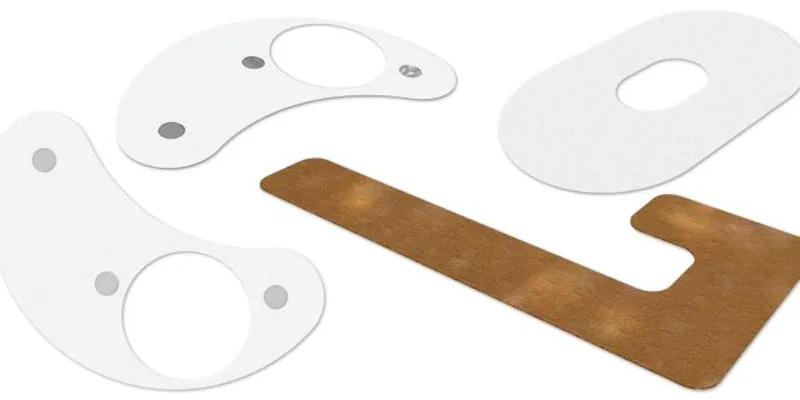
As a leading medical contract manufacturer, JBC understands that quality, manufacturing efficiency, and patient experience are paramount for skin-contact patient monitoring components.
Medical Device OEMs, Contract Manufacturing Organizations (CMOs) and Group Purchasing Organizations (GPOs) look to JBC for:
- ISO 13485-Certified Quality – In-line camera vision systems, traceability, lot documentation, regulatory submission support, and strict operations control programs (OCP)
- Class 8 Cleanroom Capacity - Multiple ISO Class 8 cleanrooms in accordance with ISO 14644 standards, with additional clean assembly space
- Lowered Total Cost of Ownership – Improved throughput and production efficiency through vertically integrated converting
- VA/VE Engineering & DFM – Design for manufacturability support, rapid prototyping, material selection assistance, and yield optimization
- Optimized Part Presentation & Delivery Systems – Pull-tabs, scored liners, custom kits, and easy-release liners for better user experience and post-processing ease
Long-Term Breathability vs. Short-Term Atraumatic Removal Single-Use Components for Clinical & Remote Monitoring
From clinical medical monitoring devices like fetal heart rate monitors to continuous glucose monitors (CGMs) for everyday at-home use, in-hospital and remote monitoring devices each address different challenges in the world of patient monitoring.

Remote (At Home) Monitoring MVTR and Breathability for Multi-Day Wear
Remote monitoring components must remain adhered to the skin for extended periods of time, requiring maximum durability and breathability to handle daily bathing, sweat, and body movement.
Wear duration: 7-21 days
Key requirements: High moisture-vapor transmission rate (MVTR), sweat/water resistance, long-term adhesion, ISO 10993-compliant biocompatibility
Most common adhesive type: Acrylic
Applications: Continuous glucose monitors (CGM), Holter monitors, remote vital sign biosensors, continuous temperature patches.

Clinical Monitoring Low-Trauma Removal for Short-Term Wear
Disposable clinical monitoring components prioritize short-term adhesion, repositionability, and skin-safe atraumatic removal for inpatient care.
Wear duration: 1-3 days
Key requirements: Atraumatic removal, ISO 10993-compliant biocompatibility, short-term gentle adhesion, repositionability
Most common adhesive type: Silicone
Applications: Single-use ECG/EKG electrode backings, disposable pulse oximetry devices, fetal heart rate monitors, acute diagnostic leads.
SKIN SAFE PATIENT MONITORING MATERIALS WE CONVERT
Medical-Grade Adhesive Tapes for Short & Long-Term Wear
Biocompatible pressure-sensitive adhesive tapes are great for skin-safe patient monitoring, but without a skilled converter, the patients who need them most can’t use them. JBC leverages in-line laminating capabilities to combine breathable, di-directional stretch carriers with skin-safe adhesives into a single high-performance material, then die-cuts them into a usable final form factor based on your processing needs. The result? Assembly-ready parts with helpful value-added features like scored & split back liners, pull-tabs, easy-release liners, custom packaging & kitting, and much more.
Explore skin-safe material combinations we commonly convert in the table below:
Tape Construction (carrier + adhesive) |
Wear Duration |
Ideal for |
Examples |
Look to JBC for |
Spunlace polyester nonwoven + acrylic adhesive |
7-28 days |
Continuous wear (7-28 days) at-home patient monitors, like CGM patches & biosensors, that require high MVTR and water resistance |
|
JBC can accommodate helpful part presentation considerations like easy peel pull-tabs and scored liners, to make it easier for patients to successfully apply the device in the comfort of their home. |
Non-woven + silicone adhesive |
1-3 days |
Short-term, acute clinical monitoring for patients with sensitive skin, including pediatric/geriatric sensor patches, disposable pulse oximetry wraps, or fetal heart rate monitors |
Our relationships with leading medical-grade adhesive tape suppliers grant us access to important performance & safety data, ensuring that the material you select won’t irritate sensitive skin types. |
|
Polyurethane/polyethylene foam + acrylic adhesive |
1-3 days |
Short term clinical applications that require high initial tack, like single-use ECG/EKG backings, telemetry pads, and fluid-resistant cushioning. |
|
JBC can die-cut thick, multi-layered foam tapes into repeatable geometries with controlled edge quality, consistent registration, and tight tolerances. |
3-14 days |
Both clinical and remote assemblies that require a secure bond to a rigid plastic enclosure with a skin-safe, atraumatic interface. |
|
As a vertically integrated converter, JBC can laminate two different adhesives into a single material stack-up, creating a custom differential adhesive component tailored to your product’s exact performance needs. |
Depending on the application, there are many different materials that could go into the construction of your stick-to-skin wearable medical devices – from single-coated, double-coated and transfer tapes – to polyethylenes such as LDPE or HDPE, polyesters such as PET, and a variety of spunlace and other non-woven fabrics.
Skin-Contact Differential Adhesive Tapes

The adhesive that works best for stick-to-skin applications is rarely, if ever, the same adhesive that will work best to bond to the next layer of the device. That’s where double sided differential tapes – tapes with a different adhesive formulation on each side of the carrier – come in.
Adhesive Tapes for Long Term Wear
Today’s wearable device applications are pushing the limits of long-term wear. Scientists and engineers are working on adhesive tapes that can deliver wear times approaching a month. 3M™ Medical Tape 4575, one example of this innovation, claims wear times up to 21 days.
Medical Grade Low Trauma Adhesives
The most common materials used for low-trauma adhesives are acrylics and silicones. Conformable foams and low basis weight non-woven fabrics provide comfortable options for carriers. Multiple constructions are available, including single and double-coated tapes, foam products, transfer tapes, and differential tapes.
Medical Pattern Coated Adhesive Tapes
One way to achieve a higher moisture vapor transmission rate (MVTR) is by using a pattern-coated adhesive. The areas of reduced coat weight enhance the ability for air and moisture to pass through the carrier. The area with a heavier coat weight allows the device to bond securely to the skin.
Here are just a few of the many material partners we work with:
We also work with customer supplied material. If you have material that you need converted, please reach out to your sales representative or contact us for additional information.







Ask an Engineer: Patient Monitoring FAQ
JBC takes a vendor-agnostic approach to material sourcing, meaning we source medical-grade adhesive tapes from many industry-leading material suppliers like Avery Dennison, Solventum, and DermaMed.
Selecting the right adhesive tape for short-term wear clinical monitoring can be a complex decision, depending on your specific product goals. It’s important to discuss with your converter to ensure you’ve selected the right material for the job.
Typically, high-tack acrylics or gentle silicone adhesives are selected for short-term 1–3-day wear clinical monitoring, depending on the goal of your wearable monitor. High-tack acrylics bond quickly and securely for emergency applications but are less gentle upon removal. Silicone adhesives provide atraumatic removal with higher repositionability – ideal for sensitive, pediatric, or geriatric skin types.
Selecting the right adhesive tape for long-term wear remote monitoring can be a complex decision, depending on your specific product goals. It’s important to discuss with your converter to ensure you’ve selected the right material for the job.
Acrylic adhesives are commonly used to secure remote patient monitoring devices to the skin for anywhere from 7-21 days, based on their consistent tack, peel, and holding power in the face of everyday movement and moisture.
By implementing helpful part presentation features like pull-tabs and scored “crack-and-peel" liners, JBC helps ensure each component can be easily handled by operators further down the assembly line or patients in the real world.
Yes, through a combination of VA/VE principles, strategic nesting strategies, and design for manufacturing recommendations, JBC can engineer the die-cutting process for maximum efficiency and throughput.
Yes, JBC provides rapid prototyping services allowing you to quickly test fit, form, and function as well as other material combinations. Powered by our digital cutting capabilities, our rapid prototyping services are a tooling-free way to quickly validate design before moving forward with full-scale production.
Your Guide to Adhesive Selection
for Disposable Pulse Oximetry Applications
Not all medical-grade adhesive tapes are created equal. And with so many options on the market, how do you know what's actually right for you?
This helpful e-guide takes a deep dive into adhesive tape selection for disposable pulse-oximetry devices, so it doesn't have to be a guessing game. The guide features important use-case criteria, a breakdown of each main type of skin-contact adhesive, and real-world tape examples and data from companies like Flexcon, Solventum, Avery Dennison, and more!
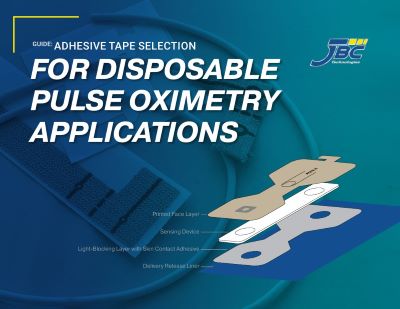
Learn More: Read our e-Book!
Related Reading
Improving Yield, Manufacturability, and Total Cost of Ownership (TCO) Partnering with an Experienced Medical Converter
The stick-to-skin layer of a wearable patient monitoring device is more than just a die-cut tape; it’s the direct patient interface that keeps critical care-giving or data-collecting devices safely and securely fastened. Partnering with an experienced medical converter who understands this is crucial.
JBC Technologies was founded on the principles of engineering innovation, manufacturing excellence, and supply chain optimization, providing full-production cycle support for skin-contact wearable components. From rapid prototyping services to post-processing and automation support, JBC’s continuous improvement approach to the die-cutting process means we’re always looking for ways to improve the manufacturability or efficiency of the entire process.
Are you looking to solve a stick-to-skin patient monitoring device challenge?